
Yellow Perch
Perca flavescens
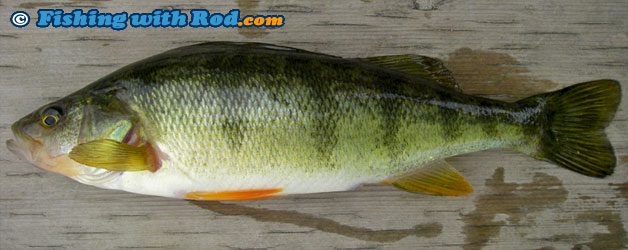
Yellow perch are commonly targeted by anglers of all ages due to their willingness to take the bait. They are plentiful, tasty and popular in a family fishing trip.
Description
This North American species is the smaller cousin of the European perch. Their average size is at the 0.5lb range, but some waters produce fish sizes up to 1.5 feet in length. The dorsal section of yellow perch is green/olive to golden/brown. Their belly is generally white or milky. Broad dark stripes can be found across the body. The colour of the fins is either yellow or light orange. The head is generally small, with a large extended jaw.
Distribution
The native distribution of Yellow perch covers most of the Atlantic and Arctic drainages. They are found in the Great Lakes, Mississippi River basin and as south as South Carolina. Introduction of yellow perch into Western Canada has resulted in takeover of ecosystem, a problem that constantly haunts fisheries biologists. In British Columbia, yellow perch are found in lakes on Vancouver Island and Gulf Islands, as well as lakes and ponds in the Okanagan Region.
Life History
Yellow perch prefer to live in lakes, ponds, but also small creeks and rivers. They are also found in brackish water of salt lakes such as the Great Lakes. Spawning takes place between February and July. They like to congregate near shore where it is heavily vegetated for protection. Their diet include insects and other aquatic invertebrates, but large perch also prey on fish eggs and juvenile fish.
Fishing Locations
When fishing for yellow perch in lakes, look for well covered waters such as reeds and weeds. Other artificial structures such as floating docks and pylons are also extremely productive.
Fishing Techniques
The techniques used for yellow perch are very simple. Due to their small size, an ultralight setup is ideal. A spinning rod up to 6 feet and a small spinning reel spooled with 4lb test line are sufficient enough for yellow perch. For kids, attach a small float to the line several feet above the hook with a few small split shots pinched onto the line. Your hook size should be between #2 to #6. If it is any smaller, you will end up deep hooking the fish each time. The most commonly used bait is worms. Thread a piece of worm onto the long shank hook and cast it out so it is near underwater structures. Don't be surprised if your float disappears immediately as yellow perch do not hesitate when they see food.
There are other popular methods for yellow perch. When targeting bigger fish, a rubber jig can be used to imitate an injured fish. Allow the jig to sink to the bottom before jigging it between short retrieves.
Small spinners will also work well as they create irresistible vibrations in the water. Be sure to carry different colours when lure fishing so you can adapt to the water colour and lighting.
This fishery is a popular family pastime because it can be participated by everyone. Yellow perch are also delicious when pan fried with bread crumb Be sure to check for daily quota of the lakes you are fishing in before each trip.