
Mountain Whitefish
Prosopium williamsoni
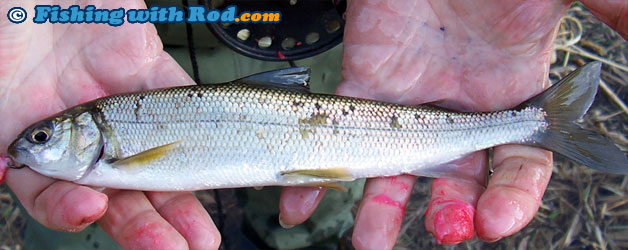
Mountain whitefish, or Rocky Mountain whitefish, are often misidentified as fish in the minnow family. In contrast, these little scaly looking critters actually belong in the salmonid family. Although they are not targeted as much as other gamefish, mountain whitefish can provide fantastic sport on ultralight spinning and fly tackle.
Description
Mountain whitefish are generally between 0.5lb to 2lb. Fish up to 70cm or 6lb have been recorded in the past. Silver in colour, their body is generally slender and almost cylindrical. Their head is short, with a small mouth that sits under the overhung snout. Their fin colour varies between grey and yellow. One distinct characteristic that separate them from the minnow family is the presence of a adipose fin.
Distribution
Mountain whitefish is a freshwater species that can be found in many large watersheds across North America. These include river drainages in Northwest Territory, Hudson Bay, Western Canada, Northwest and Midwest of US.
Life History
Mountain whitefish can live up to 14 years and population growth is relatively slow. Spawning takes place in late fall and early winter. Their diet varies seasonally. During summer months, mountain whitefish feed on benthic insects or any aquatic critters that are available such as plankton and mollusks. On coastal streams, their diet switches to eggs during salmon spawning season. From late winter to early spring, large mountain whitefish feed on juvenile salmonid and trout. Natural predators of mountain whitefish include lake trout, bull trout and rainbow trout.
Fishing Locations
Mountain whitefish can be found in shallow lakes, clear streams and even larger silty rivers. Presence of fish is seasonal, depending on what food is available at the time. Look for waters where high volume of benthic insects, fish eggs are present.
Fishing Techniques
Mountain whitefish can be caught easily by spin casting, float fishing and flyfishing. Small spinners and spoons under 1/8oz imitate juvenile salmon or trout. When fished with ultralight spincast setup, they can be very effective in streams where these whitefish are feeding heavily on juvenile fish.
Floatfishing with a small piece of worm or egg sac is the most productive method. The setup is fairly easy. Simply tie a small hook (size 6 to 10) a few feet below a small float. Clamp on a few split shots a foot or so above the hook. Drift the setup in moderate to slow flows will usually produce a fish or two.
Flyfishermen who target coastal cutthroat trout will often encounter the odd mountain whitefish because both species predate on the same food. Small leeches, egg and minnow patterns in streams will usually work very well.