
Pink Salmon
Oncorhynchus gorbuscha
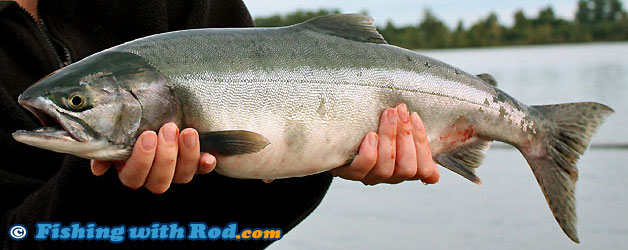
Due to their short life span, the pink salmon is the smallest member of the five pacific salmonid species. Each year, between July and September, one can find millions of "humpbacks" migrating into all the major rivers. Despite it does not grow very large, pink salmon is a great sportfish. Its willingness to take lures and flies makes it one of the favorite species for anglers at all ages in the Pacific Northwest.
Description
Pink salmon belongs in the Salmonidae family, it is closely related to its large cousins such as the chinook, coho, sockeyes and chums. The average size of a pink is between 4 to 6 pounds, but monsters up to 12 pounds can be caught at times. In the juvenile stage, unlike other salmon species, pinks are silver in colour and do not have any marks (spots or parrs). The morphological characteristics are quite distinct, so they are very easy to be identified. When in the ocean, pinks are silver in colour, with a slightly darker back. Large oval spots can be found along its back, as well as the entire tail fin of the fish. These spots are much larger than the spots on a coho and chinook salmon. During the fall migration, adult male will undergo changes in morphology. A hump back and a slight hooked jaw will develop, while females remain relatively normal in body shape and colour. As they migrate into streams for spawning, their body colour will turn to dark green.
Distribution
In BC, pink salmon can be found be found in most major river systems, such as the Fraser and Skeena. They can also be found in Alaska as well as parts of Washington, Oregon and Northern California. They also exist in countries of the Western Pacific such as Japan, Korea and Siberia.
Life History
The life history of pink salmon is a typical salmonid life history. The life span is only two years long. Youngs are hatched in streams and they rear several months in there before migrating towards the ocean. Along the way, they often encounter predators such as birds, bull trout, searun cutthroat trout, northern pikeminnow and groundfish (rockfish, lingcod). The ocean phase is the major phase of the entire life cycle. After spending less than two years in the ocean, they will migrate back into streams once again to spawn and die.
Fishing Locations
Depending on the year, pink salmon can be found in large numbers between the July and September. In Southern BC, adult pink salmon return in large numbers during odd years, while northern rivers will have their peak runs of pink salmon in even years. In the Fraser River, as mentioned earlier, these fish will return in millions starting in late August until late September in odd years. You can fish along any part of the Fraser River, as long as the fish is moving through with the tide. If the fish are not there, it is better to stay home and watch your favorite fishing shows. Pink salmon travel in large schools, so if you catch one, expect to catch many.
Vancouver Island also has many excellent rivers for pink salmon fishing. Oyster River, Campbell River are just a few famous ones. Pink salmon can also be caught when shore or boat fishing in the sea. They are extremely aggressive at the ocean phase and can be caught with ease. Please check the fishing regulations before heading out to any one of the rivers mentioned above. Usually there are bait bans, non-retention, hook restrictions and daily quotas that you will need to look out for.
Fishing Techniques
The fishing techniques for pink salmon are simplistic, anglers at all ages and all levels can usually master the techniques with ease. They will often chase colourful lures, jigs and flies without any hesitation, making them one of the easiest salmon to catch. The rod and reel set up for pink salmon should not be too heavy, otherwise it takes away the fun. Since the fish are not very big, your fishing line should be between 6 and 10lb test. The rods should be light to medium action, flexible is ideal. The length of the rod is dictated by the style of your fishing. If you are spinning, then a 6 foot rod is good enough. If you are drifting in streams, a 10 foot rod is necessary for you to be able to fish comfortably. For flyfishing, depending on the condition of the waters you are fishing in (current, depth), a 5 or 6 weight rod is strong enough.
Any type of lures should work, as long as it is heavy enough to reach the schools and that the colour is right. Some of pink salmon's favorite colours include pink, red, orange and green. Some lures that you may want to try out include Gibbs Croc and Koho spoons (1/4 to 3/8 ounce is ideal), Apex, Deadly Dick, Buzz Bomb, spin n glow, wool and pink worm. For more information on pink salmon fishing
When fishing for pink salmon in the ocean, look for signs of fish. These include feeding on the surface, leaping out of the water or even just watching fish swimming around in the water! A few years back while fishing on Vancouver Island, I was able to spot large schools of pink salmon from a pier by looking into the water. Being unprepared to fish, I had a few croc spoons (silver colour) in my tackle box, I tied one on and began to jig in the water. As I watched my spoon rise and sink close to the surface, I could see at least 20 pink salmon sitting below the spoon. Everytime the spoon sank, some of the fish would swim up and peck at it. Eventually their hunger won over their fear, and I was able to have many hookups. Catching these fish in the ocean was extremely exciting, because I was able to witness each fish biting onto the lure before setting the hook.
Fishing for pinks in large rivers such as the Fraser River is also easy. Colour selection is crucial as your lure needs to be seen by the fish in the silty water.