
Steelhead
Oncorhynchus mykiss
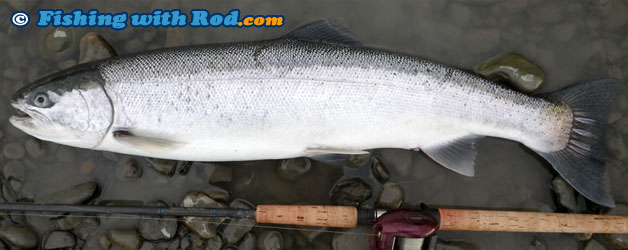
Steelhead, which are sea-run rainbow trout, are considered as fish of a thousand casts. They are highly regarded by river anglers throughout the Pacific Northwest due to their strength and beauty. It can sometimes be hard to entice, but fighting one is an experience that would not be forgotten in your lifetime.
Description
Steelhead are often referred to as squaretails due to the shape of their caudal fin/tail. Unlike resident rainbow trout, their elongated body is metallic silver during the ocean phase. Small black spots can be found along their back above the lateral line. Their square tail is an important key used for identification. their caudal section (the section between the tail fin and the anal fin) is wide. When sexually matured, pink or orange patches begin to develop on the gill plates and along the lateral lines. Matured fish range between 6 to 15lb, however fish up to 20 to 30lb are produced each season in some river systems such as the Thompson and Skeena watersheds.
Distribution
Steelhead is originally an Eastern Pacific species. Returning spawning adults can be found from Alaska to northern California and parts of Russia. Unfortunately, many populations are now threatened or endangered due to overfishing and habitat degradation. Steelhead have also been introduced into the Great Lakes and parts of South America.
Life History
Steelhead's life cycle is anadromous, which is one of many life adaptations that the species Oncorhynchus mykiss (rainbow trout) has developed. These adaptations have allowed this successful species to established populations across North America since the last glaciation.
Their life history is almost identical to other pacific salmon species. Young fish hatch in streams, and rear and feed in pools. Juvenile fish primarily feed on aquatic insects. At around 20cm, steelhead fry migrate downstream and undergo smoltification in the estuaries, a process that transforms them from freshwater fish to ones that can adapt in saltwater. From smolts to sexually matured adults, steelhead spend between two to three years in the ocean. Their primary food source is baitfish such as herring and sardine. Due to higher productivity in the ocean than streams and lakes, steelhead are able to grow to a much larger size than a freshwater rainbow trout. Once matured, steelhead return into their natal streams and spawn.
Unlike other pacific salmon species, some steelhead may survive after spawning, return to the ocean and become repeat spawners. There are two major seasonal populations of steelhead, summer run and winter run. As the name implies, summer run steelhead return to their natal streams during the summer months for spawning, while winter run fish return between the months of December and May.
Fishing Locations
Southern British Columbia's winter steelhead is the most popular species sought after by anglers between December and April. Due to their low abundance, they are usually only targeted in streams. In the Lower Mainland, popular steelhead streams include Chilliwack River, Chehalis River, Capilano River, Allouette River, Cheakamus River and Squamish River. A total catch and release of wild fish applies to all Southern waters, while some streams allow anglers to retain hatchery fish. Please check out the daily quota as well as annual quota of your region before fishing. On Vancouver Island, the Stamp and Cowichan Rivers offer a rather productive winter hatchery steelhead fishery.
Summer run steelhead are commonly targeted in the Skeena region in September and October. The Thompson River in the Thompson-Nicola Region is known for its large summer run steelhead. Its opening season differs from year to year, so please be sure to check the regulations prior to planning your trip.
Fishing Techniques
Drift fishing is the most popular method when targeting steelhead in rivers. A float is used as a strike indicator. What follows under a float is a sufficient amount of weight to balance the float, and a leader that ranges between one to two feet long depending on water clarity and river velocity is tied onto the main line. There are hundreds of presentations that you can choose from for steelhead, but there is not one single best bait, lure or fly that can consistently produce fish. It is best to try out several until you find a couple that you have confidence in.
Some of the more commonly used bait include roe sacs, roe chunks, ghost shrimps (bugs), cooked shrimps, and single eggs. Artificials that can be used include wool, corkies, spin n' glows, gooey bobs and pink worms.
Flyfishing, particularly double-handed or spey fishing, is another method for targeting steelhead that has gained popularity in recent years.
When fishing for steelhead, it is best to cover runs thoroughly and effecitvely. The objective is to find the fish, not letting the fish to find you. After covering a piece of water thoroughly, move onto the next section until you find a fish. It is a species that can be easily enticed, but simply hard to find due to their low abundance. Success rate usually increases after several hook-ups because you will know which waters are steelhead worthy or not. If you put in the hours, most likely you will be rewarded.