
Chum Salmon
Oncorhyncus keta
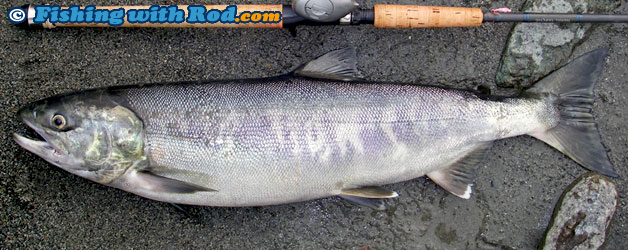
Also known as "dog salmon" due to their canine appearance during the spawning phase, chum salmon are one of the favourite target species among anglers due to their high abundance and powerful strength. Although they are not known as a great table fish, they are economically important as they make up a large portion of the commercial catches each year.
Description
During the ocean phase, chum salmon possess the metallic blue colour on their back while the rest of the body remains silver, similar to their salmonid cousins. It is difficult to distinguish between a chum salmon and a coho or sockeye salmon without a close examination of the fins and gill rakers during this phase. Chum salmon have fewer but larger gill rakers. Once they enter the rivers, their spawning colours emerge. Streaks of purple, green, pink bars can be seen on the side of their body. A hook snout and large teeth will develop in males while a lateral black streak can be seen in females. At spawning age, most fish will range between 10 and 20 pounds while the odd 20+ pounders can be found occasionally.
Distribution
Chum salmon is widely distributed compared to other pacific salmon species. They can be found along the west coast from California to Alaska, as well as parts of Japan and the Arctic.
Life History
Chum salmon's life cycle is a typical anadromous life cycle. Their average life span is four years but some may reach six years. After emerging from the eggs around late winter, fries of chum salmon do not reside in freshwater for a period. They move into the estuary and feed on small insects and other aquatic organisms before heading into the ocean. Their ocean migration takes up most of their life span and their food composition changes from zooplankton to small bait fish as they grow. After spending several years in the ocean, adult reach sexual maturation during fall and begin to migrate back into the rivers. Reproduction takes place in small river channels, chum salmon are typically shallow spawners. The female dig up redds where eggs are laid while males fight for their territory and ideal mate. In average, a female chum salmon can lay up to 4000 eggs, but only 70% or so are fertilized.
Fishing Locations
In the Lower Mainland, chum salmon make their annual return into the river between October and December. During this period, they can be caught in any rivers that have a strong run. These rivers include Stave River, Squamish River, Cheakamus River, Vedder River, Harrison River, Cheahalis River, Indian River and many other sloughs in the Fraser Valley. They can also be caught by barfishing along the Fraser River. Prior to entering the river, boat anglers can enjoy catching them by trolling in the ocean. In other parts of BC, they can pretty much be found in every salmon spawning river. Be sure to check the fishing regulations for openings and daily quotas of chum salmon before heading out.
Fishing Techniques
Chum salmon can be caught with ease if you are fishing at the right place and time. To successfully bring the fish in is another story. To ensure that you will not lose the fish, it is important that you use proper tackle. Heavy enough rod, reel and line can not only put up with the strong fight, it also reduces fighting time to ensure the survival of the fish when released. Chum salmon can be caught with various techniques, these include driftfishing with a float, bottom bouncing, spinning with spoons or spinners in rivers, trolling in the ocean with hootchies. Typical colours used for chum salmon include green, chartreuse, pink, peach, orange and purple.